Wolverine: The Hybrid Benchmark
Categories
Character Design & Editorial Portrait
Client
Project
Services
Art Direction
Digital Painting
AI Workflow (ControlNet + LoRA)
Year
Overview
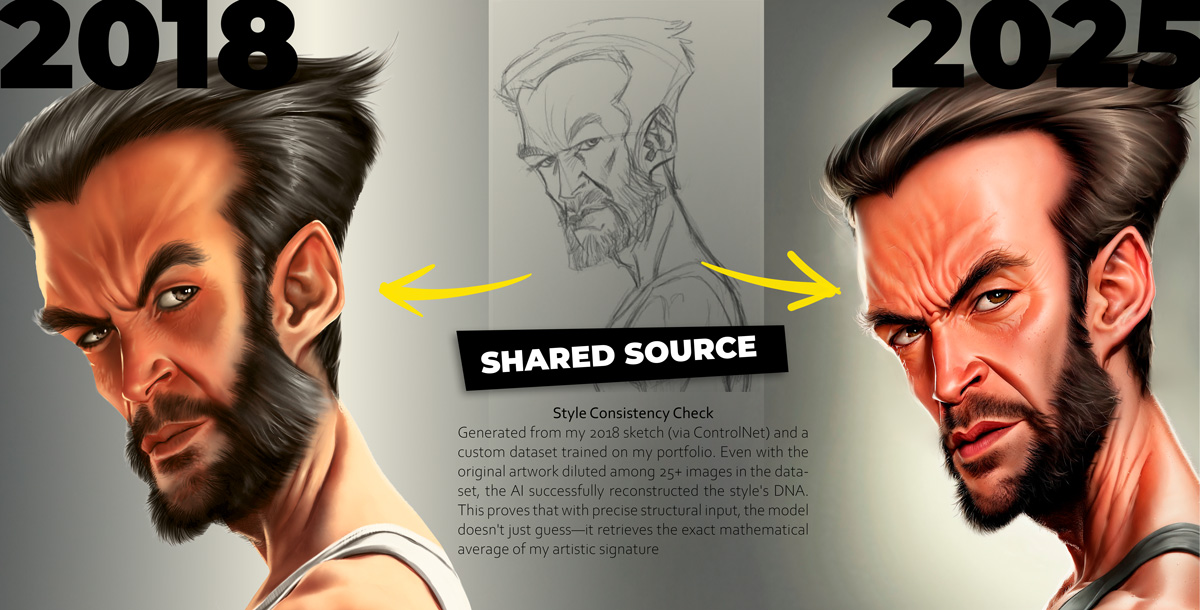
A comparative study on Generative AI control applied to caricature. While AI excels at creating “correct” realistic faces, it inherently struggles with intentional distortion—the soul of a good caricature. Without structural guidance, models tend to either “normalize” features back to symmetry or create bizarre glitches instead of artistic exaggerations.
The Challenge
Algorithms are trained to fix errors, but in caricature, “errors” are the point. A simple text prompt would fail to capture the specific muscle tension and distorted bone structure I defined in my 2018 artwork. The goal was to force the AI to enhance the exaggeration, not repair it.
The Hybrid Process:
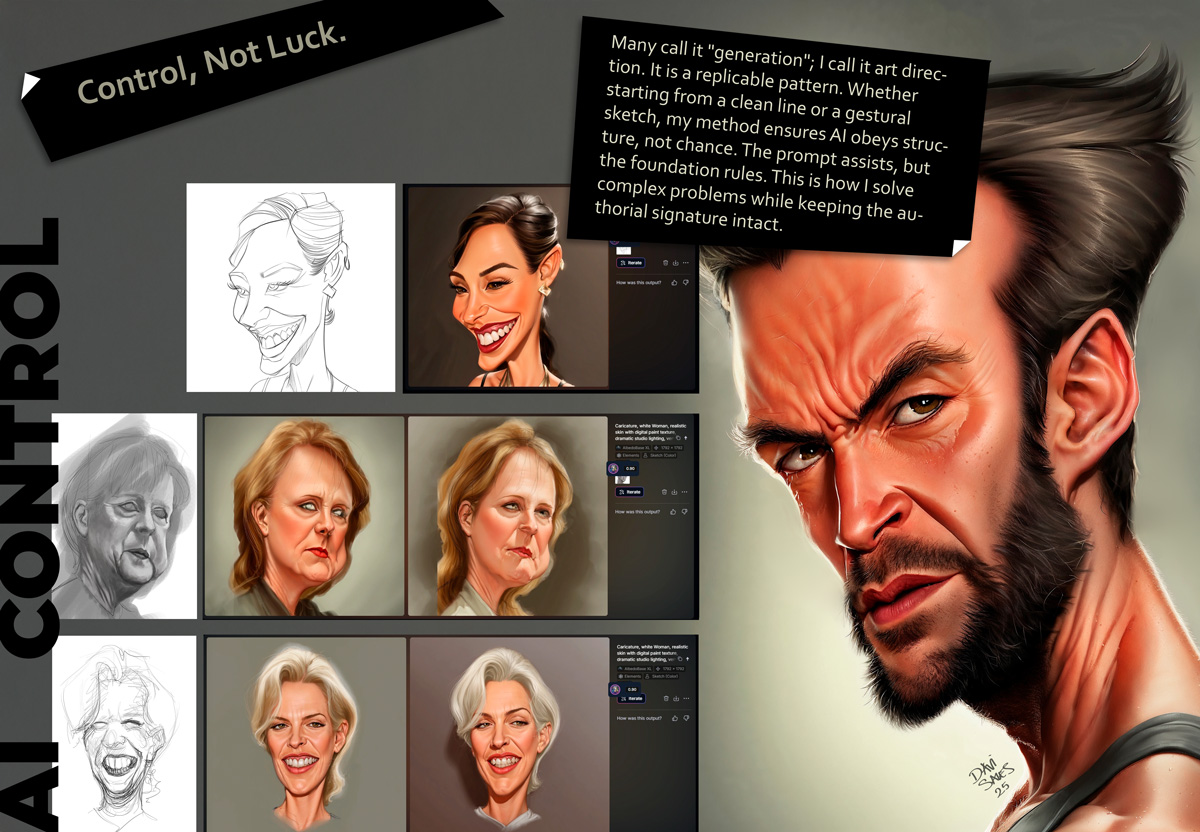
Instead of letting the machine “hallucinate,” I fed the system my original pencil sketch as a non-negotiable blueprint. By using ControlNet to lock in the geometry—and a custom dataset trained on my portfolio to capture my specific painting technique—I transformed the generative model into a high-fidelity rendering engine guided by my own artistic memory.
The Result:
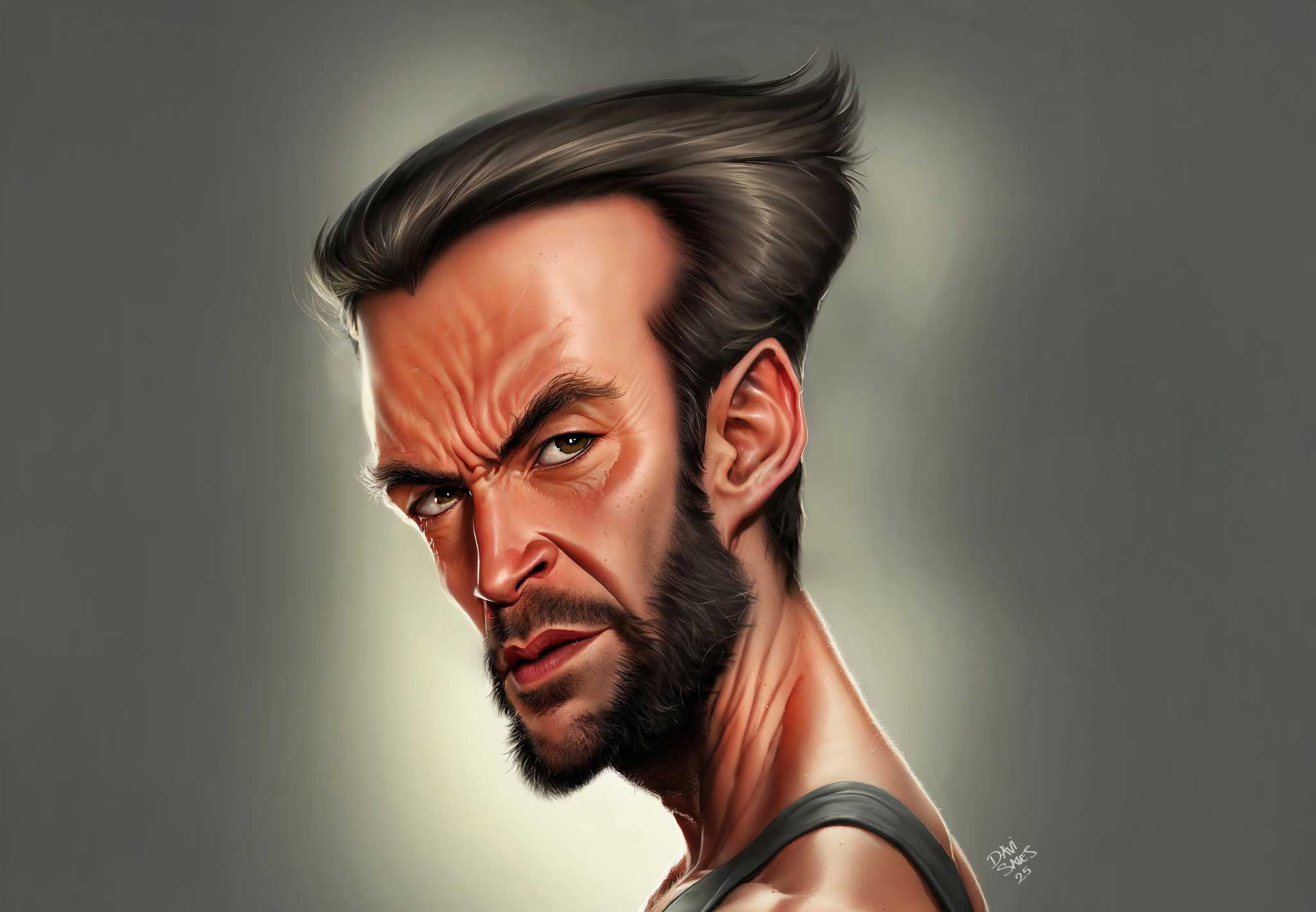
The AI honored the distortion rather than correcting it. The 2025 result retains the original’s aggressiveness and caricatured anatomy, proving that even with advanced neural networks, the artistic foundation remains the only safeguard against generic mediocrity.
The Fail-Safe Guarantee:
The tool accelerated rendering, yet the vision remained anchored in the hand-drawn stroke. Ultimately, that is the promise of Studio: technology is an amplifier, not a crutch. If the algorithm fails, my hand ensures the delivery of a masterpiece-quality result—because the skill lies with the artist, not the software.